楚汉骄雄
China’s ‘Nvidia alternative’ Moore Threads posts 147.42% growth in H1 revenue amid GPU sector’s expansion_我的网站

一 | Exxon Mobil is buying Pioneer Natural Resources in an all-stock deal valued at $59.5 billion, its largest buyout since acquiring Mobil two decades ago, creating a colossal fracking operator in West Texas. Including debt, Exxon is committing about $64.5 billion to the acquisition, leaving no doubt of the Texas energy company's commitment to fossil fuels as energy prices surge. Pioneer shareholders will receive 2.32 shares of Exxon for each Pioneer share they own.“I think fossil fuels, as the world looks to transition and find lower sources of affordable energy with lower emissions, fossil fuels oil and gas are going to continue to play a role over time,” Exxon Mobil CEO Darren Woods said during an interview with CNBC. “ That may diminish with time. The rate of that is, I think, not very clear at this stage. But it will be around for a long time.” Woods explained that Exxon and Pioneer will be able to use their combined capabilities to drive down emissions and produce lower carbon intensity oil and gas. Exxon purchased XTO Energy in 2009 for approximately $36 billion. In the late 1990s, the merger between Exxon and Mobil was valued around $80 billion.The deal with Pioneer Natural vastly expands Exxon's presence in the Permian basin, a massive oilfield that straddles the border between Texas and New Mexico. Drilling the Permian accounted for 18% of all U.S. natural gas production last year, according to the U.S. Energy Information Administration.Pioneer's more than 850,000 net acres in the Midland Basin will be combined with Exxon’s 570,000 net acres in the Delaware and Midland Basin, nearly contiguous fields that will allow the combined company to trim costs. That is a big driver of the deal. Natural gas rigs in operation have declined over 26% in the U.S. since the start of the year, according to government data, largely due to the rising costs for drilling materials and labor over the past two years. “Their tier-one acreage is highly contiguous, allowing for greater opportunities to deploy our technologies, delivering operating and capital efficiency as well as significantly increasing production,” Woods said of Pioneer in a prepared statement. The company will have an estimated 16 billion barrels of oil equivalent in the Permian.Once the deal closes, Exxon Permian production volume will more than double to 1.3 million barrels of oil equivalent per day, based on 2023 volumes. It's expected to climb to about 2 million barrels of oil equivalent per day in 2027. “The combination of ExxonMobil and Pioneer creates a diversified energy company with the largest footprint of high-return wells in the Permian Basin,” Pioneer CEO Scott Sheffield said in a prepared statement. Citi's Alastair Syme wrote that the transaction could provide multiple benefits to Exxon. “Across the industry, the logic of consolidation in the highly fragmented Permian shale remains compelling with significant gains to be achieved from economies of scale by minimizing facilities spend, optimizing drilling and reducing" general spending, Syme wrote. Exxon is flush with cash. The company posted unprecedented profits last year of $55.7 billion, breezing past its previous record of $45.22 billion in 2008 when oil prices hit record highs.Exxon Mobil Corp. has been using some of that cash on acquisitions. In July the company announced that it was buying pipeline operator Denbury in an all-stock deal valued at $4.9 billion.Pioneer Natural has been making similar maneuvers. In 2020 the company said it was buying Parsley Energy in an all-stock deal valued at approximately $4.5 billion. It then purchased DoublePoint Energy in a cash-and-stock deal worth about $6.4 billion in 2021.The boards of both companies have approved the transaction, which is expected to close in the first half of next year. It still needs approval from Pioneer shareholders. Shares of Exxon fell more than 4% in Wednesday morning trading.。
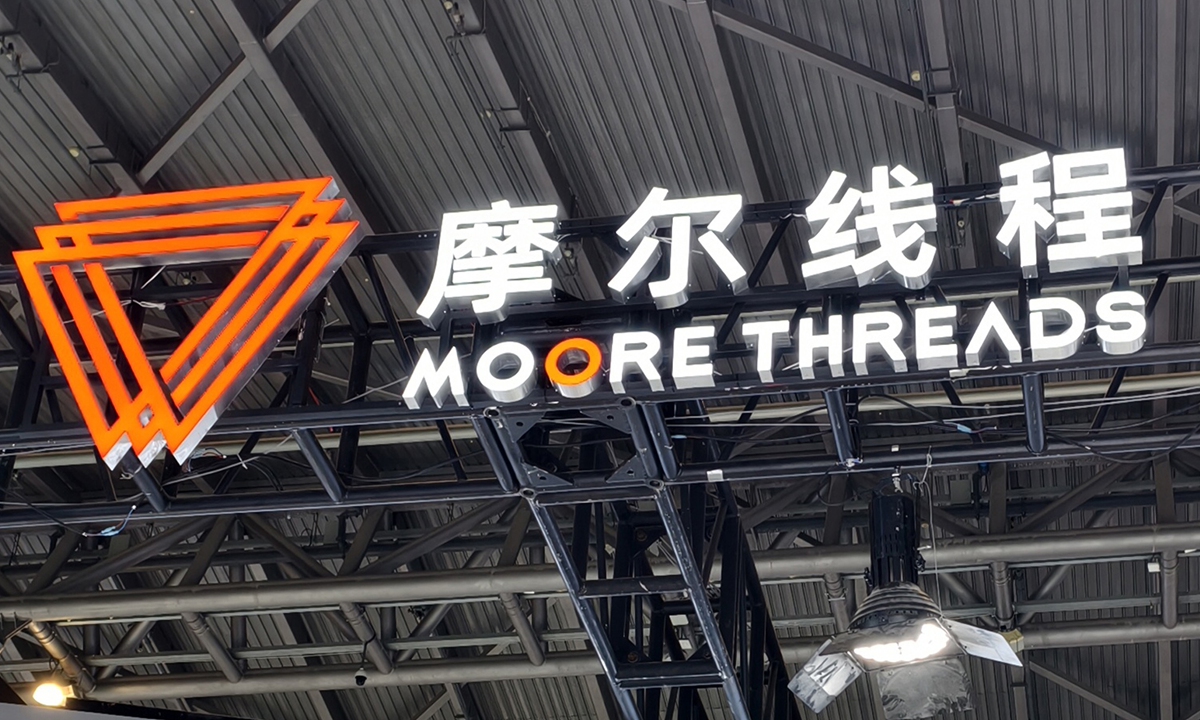
A logo of Moore Threads at the 2025 World Artificial Intelligence Conference in Shanghai on July 28, 2025 Photo: VCG
Chinese chipmaker Moore Threads, often described as "China's Nvidia" or "Nvidia alternative," reported fast revenue growth in the first half of 2026, which exceeded its entire 2025 full-year figure. The growth accompanied other domestic graphics processing unit (GPU) companies' gains, marking a clear shift toward profitability.
Moore Threads, China's GPU leader, reported 1.736 billion yuan ($257 million) in first-half revenue, up 147.42 percent year-on-year. Gross profit reached 989 million yuan, up 103.78 percent, while net losses attributable to shareholders narrowed sharply by 95.73 percent, according to the financial results released on Sunday.
The company attributed the strong growth to booming artificial intelligence (AI) demand for full-function GPUs and the accelerated commercialization of its Kuae intelligent computing clusters.
Moore Threads maintained heavy research and development (R&D) spending of 769 million yuan in the first half, up 38.16 percent year-on-year, bringing cumulative investment since 2022 close to 5.9 billion yuan. As of the end of June, it filed 2,167 patent applications and held 788 authorized patents, which ranked among the top ranks of domestic GPU enterprises, the company said.
As a result of its investment in R&D, Moore Threads' flagship MTT S5000 GPUs have realized large-scale sales, with deployments in Beijing, Wuxi, Hangzhou and other cities. The first batch of intelligent computing clusters passed national security and reliability evaluations and achieved multiple "domestic chip training domestic models" breakthroughs. Its MUSA software stack now supports more than 800,000 developers.
Moore Threads also announced plans for an IPO in the Hong Kong market. It was listed on Shanghai's STAR Market on December 5, 2025.
"Chinese firms are increasingly turning to domestic suppliers, accelerating demand for local AI accelerators. Under the combined forces of surging inference computing needs and continued capital expenditure by major cloud providers, the domestic GPU and AI chip sectors are moving from an investment phase into a commercialization and profit-delivery phase," Yang Delong, chief economist at Shenzhen-based First Seafront Fund, told the Global Times on Sunday.
Biren, Moore Threads, MetaX and Enflame Technology are dubbed China's "four little dragons" in the GPU sector. Apart from Moore Threads, the other companies also showed rapid growth in their recent financial results.
In June, MetaX reported first-quarter revenue of 562 million yuan, up 75.37 percent year-on-year, and said that it had begun volume sales of its next-generation general-purpose GPU C600, representing further breakthroughs in the areas of domestic adaptation and supply chain autonomy control.
Enflame Technology reported 1,474.85 percent year-on-year growth in its revenue in the first quarter. The company estimated that its first-half revenue would grow 258.68-289.13 percent, likely to reach the level of the entire year of 2025.
Domestic GPU company Biren in March released its first financial results after being listed in Hong Kong. It reported 207.2 percent full-year growth in revenue in 2025, with gross profit up 210.8 percent.
Fellow AI chip leader Cambricon also delivered equally robust results on Friday. Its first-half revenue hit 5.996 billion yuan, up 108.13 percent year-on-year, while net profit attributable to shareholders rose 122.61 percent to 2.311 billion yuan.
Growth was driven by deeper partnerships with leading financial and internet firms and scaled commercial deployments. Cambricon said that it completed adaptation support for major Chinese open-source AI models including GLM, DeepSeek, Qwen, Kimi and MiniMax, strengthening its domestic AI computing ecosystem.
Ma Jihua, a veteran industry insider, told the Global Times that multiple Chinese companies are advancing along different technological routes covering high-, mid- and low-end products.
"With rapidly expanding capacity, they are better meeting domestic needs and beginning to reach global markets, thereby promoting more accessible AI," said Ma.
"The AI technology sector's high prosperity is expected to persist, remaining a core investment theme with substantial medium- and long-term opportunities," said Yang.
。
Current article:http://mzssrz.gamajionghuanmuniuzhuanguchu.cyou/list_bnwv/domuyo0.html
Published on:11:46:19


